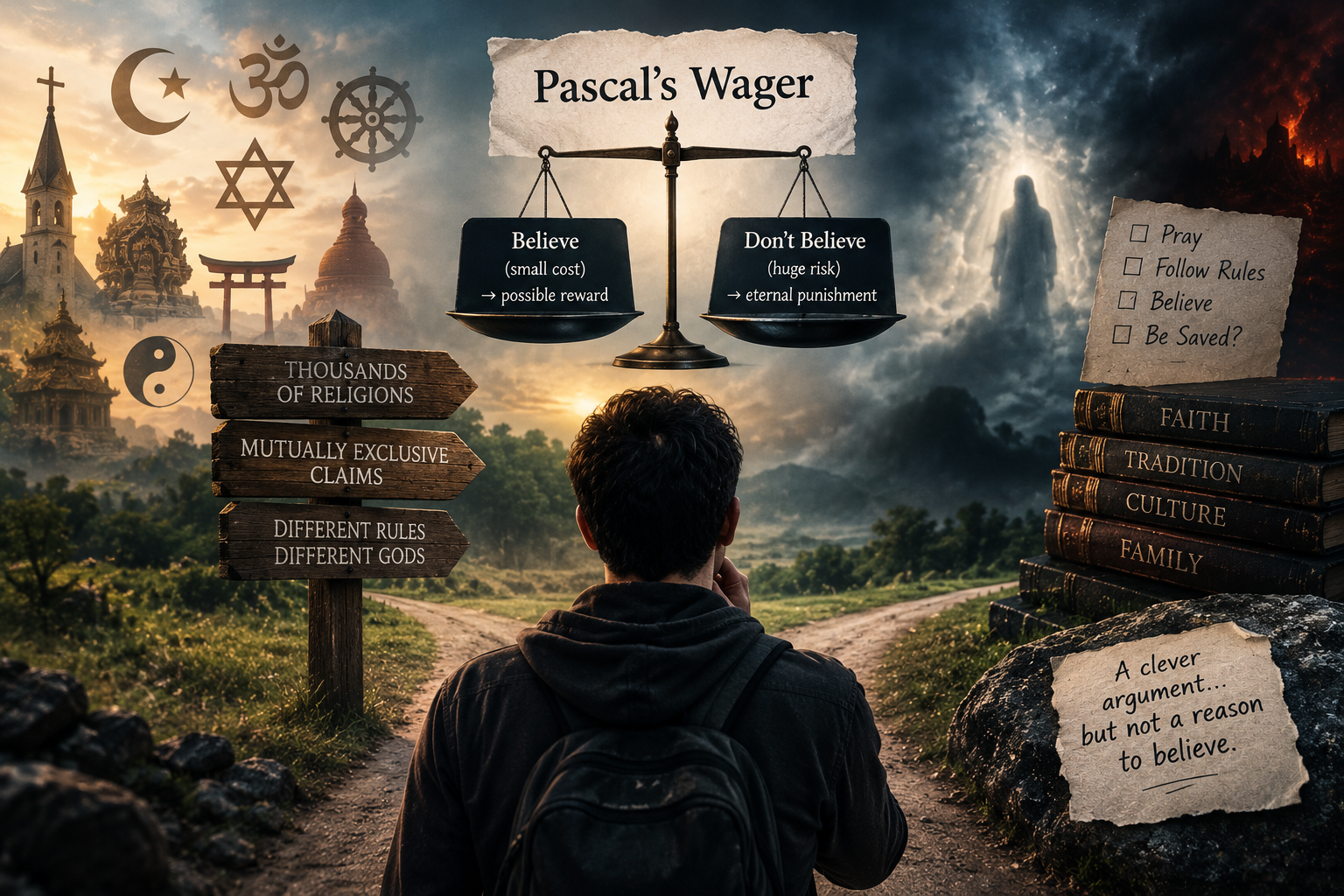
Pascal's Wager gets brought up a lot in these conversations, the idea that believing in God is the rational bet even under uncertainty, because the potential cost of wrongly disbelieving, eternal damnation, vastly outweighs the cost of wrongly believing, a bit of wasted devotion. On its face it has a certain clean, game-theoretic elegance to it.
The problem I kept running into is what philosophers call the many-gods objection, and once I actually thought it through, it broke the wager for me entirely. The argument only works if there are exactly two options on the table, a specific God who rewards belief and punishes disbelief, or no God at all. In reality, there are and have been thousands of different religious traditions throughout history, many making mutually exclusive claims about which specific beliefs and practices are required for salvation and which will be punished. If I "wager" on one tradition's version of God, I'm simultaneously betting against every other tradition's version, some of which might punish exactly the beliefs I'd be adopting to hedge against the first.
There's also something that never sat right with me about the wager as a basis for genuine faith in the first place. It's explicitly a self-interested calculation about hedging cosmic risk, not a claim that the belief is actually true. A God who rewards people for strategically pretending to believe, or for talking themselves into belief purely to avoid punishment, seems like a strange thing to worship even if such a God existed.
I think the wager is clever as a piece of decision theory. I don't think it's a reason to actually believe anything.
Post
Why I Don't Find Pascal's Wager Convincing
Log in or create an account to leave a comment.
Pascal er wager niye matha kharap? Jibon e kichu kaaj nei tor? Boka choda ar ki likhbi na.